History channels

AI History Video Generator for Faceless Shorts

Turn one concrete historical question into a publish-ready vertical Short using an AI history video generator built for faceless documentary creators. ChronoReels pairs fact-risk script review, four bespoke Remotion visual engines, per-scene visual swaps, Whisper word-aligned captions, and -16 LUFS audio mixing in one browser workspace.

Launch the AI history video generator with a topic

9:16 vertical · 150 free credits
Try a prompt:

150 free credits on signup · 1080×1920 vertical export · English & Chinese narration with Whisper-synced captions.

Why ChronoReels fits this niche

  • Separates confirmed archaeological and textual evidence from popular legend before you voice or render.
  • Four history-tuned Remotion visual engines replace repetitive AI slideshows with real framing variety.
  • Swap any inaccurate historical scene individually with two free retries per storyboard before paying render credits.
  • Outputs watermark-free 1080×1920 H.264 MP4s with bilingual narration, safe-zone captions, and a ready posting kit.

High-retention beat structure

  1. Lead with one physical artifact, inscription, or engineering contradiction in the first 3 seconds (under 12 words).
  2. Anchor the exact year, location, and primary museum or archival record by scene two so viewers trust the premise.
  3. Advance through one clear cause-and-effect revelation per beat rather than listing encyclopedia trivia.
  4. Close cleanly the moment the opening question is answered — no slow subscribe reminders that depress loop replays.

How this AI history video generator turns one question into a 9:16 MP4

  1. Step 01

    Enter one specific historical question and pick a verified story angle from the free topic pass.

  2. Step 02

    Review the structured 5-to-7-beat script alongside built-in fact-risk annotations and safer phrasing notes.

  3. Step 03

    Inspect every generated storyboard frame inside Investigation Desk, Dark Mystery, Animated, or Documentary Motion — retrying up to two off-era scenes for free.

  4. Step 04

    Confirm the 100-credit render to export a 1080×1920 MP4 with Whisper-synced safe-zone captions, SFX transitions, ducked music, and copy-paste posting metadata.

Sample 45-second script blueprint from our AI history video generator

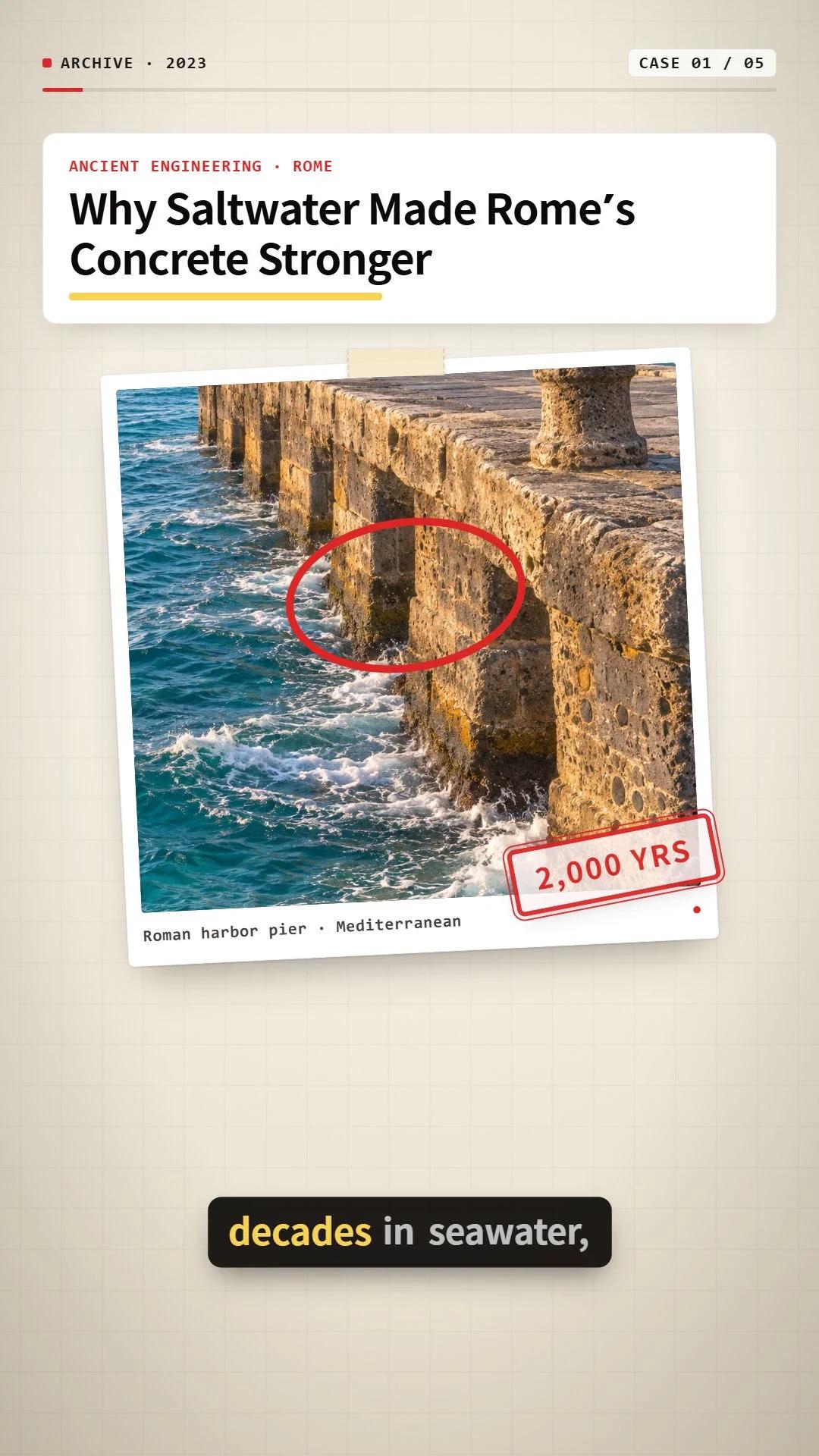
Why Did Roman Marine Concrete Survive 2,000 Years in Seawater?

TimingSpoken narrationVisual & motion framing
0:00 – 0:05
Beat 1 · Hook
“Modern steel-reinforced seawalls crack within decades, yet Roman concrete harbors still stand after 2,000 years.”Overhead Investigation Desk: cracked modern pier Polaroid vs Roman harbor pier connected by red string.
0:05 – 0:13
Beat 2 · Anchor
“Around the first century BCE, Roman builders mixed volcanic ash from Pozzuoli with quicklime and seawater.”Dated archive map stamp pinning Pozzuoli Bay and Vitruvius masonry notes.
0:13 – 0:25
Beat 3 · Mechanism
“In 2023, researchers at MIT showed hot-mixing left tiny reactive lime clasts trapped inside the mortar.”Microscopic cross-section card with animated callout zooming into white lime inclusions.
0:25 – 0:36
Beat 4 · Turning point
“When seawater seeps into a hairline fracture, dissolved calcium recrystallizes and seals the crack before it spreads.”Animated bar comparison contrasting decades-long modern corrosion vs self-healing Roman mineral crystallization.
0:36 – 0:44
Beat 5 · Payoff
“What engineers once dismissed as sloppy mixing turned out to be the secret behind history’s longest-lasting concrete.”Verdict stamp card closing cleanly on the ancient breakwater with final synced caption.

Why generic slideshow tools fail history Shorts channels

Running a faceless history channel is one of the highest-retention formats on YouTube Shorts and TikTok, yet most creators stall after ten uploads because their videos look indistinguishable from every other AI slideshow. Generic generators drop anachronistic armor, modern streetlamps, or fantasy castles behind a rushed voiceover, immediately prompting knowledgeable viewers to comment 'fake' and scroll past.

Using a dedicated AI history video generator changes how viewers judge credibility in the first two seconds. Instead of flat single-image zooms, ChronoReels frames historical mysteries inside tactile archival desks, noir dossier clippings, animated educational stages, and full-frame documentary pushes. Paired with dated overlays and concise lower-third safe-zone captions, your channel looks researched rather than auto-spun.

Reducing historical hallucinations with built-in fact-risk review

History audiences reward precision and punish invented motives. A strong AI history video generator must do more than write punchy hooks — it should help you separate documented inscriptions, radiocarbon dates, and museum records from later legends or scholarly hypotheses.

In ChronoReels, your first topic generation and first script pass cost zero credits. Every draft surfaces fact-risk notes highlighting uncertain dates, disputed attributions, or claims that benefit from attribution phrases such as 'historians propose' or 'according to surviving inscriptions.' You edit any line directly before generating visuals or paying render credits, ensuring your channel stays accurate and monetization-safe.

Matching the right visual engine to your historical niche

Not every historical topic belongs in the same visual wrapper. Engineering feats, ancient architecture, and trade networks shine inside Investigation Desk, where overhead Polaroids, comparison charts, and red-string pins make mechanisms effortless to scan. Unexplained artifacts, ancient shipwrecks, and palace intrigues fit Dark Mystery’s midnight cinema palette and glowing timelines.

For lighthearted cultural topics like ancient food or daily urban life, Animated stage visuals deliver comic clarity up to 3 minutes, while Documentary Motion scales seamlessly to 3–5 minute vertical explainers for TikTok Creator Rewards. Save your preferred style, voice, and language inside a reusable Series so every upload ships with consistent channel branding.

Ready-to-test prompts for this niche

“Why did Roman marine concrete grow stronger in seawater?”

Open in Studio

“Why is there writing carved across Wu Zetian’s Wordless Stele?”

Open in Studio

“How did the Rosetta Stone’s three scripts unlock Egyptian hieroglyphs?”

Open in Studio

Export your first vertical Short with 150 free credits

Test topic angles, fact-risk script review, per-scene visual swaps, and full 1080×1920 MP4 rendering before choosing a monthly plan.

Primary sources & policy references

Frequently asked questions

How does this AI history video generator reduce historical hallucinations?

Topic and script passes surface fact-risk notes and safer wording for disputed motives or approximate dates so you can verify claims against museum or academic records before committing render credits.

Can I make 3-minute vertical history explainers as well as 45-second Shorts?

Yes. Documentary Motion supports up to 5 minutes and Animated stage supports up to 3 minutes, while Dark Mystery and Investigation Desk are tuned specifically for high-retention 30–60 second Shorts.

What if one AI-generated historical scene has an anachronism or wrong costume?

Every storyboard lets you inspect frames individually before rendering and regenerate up to two scenes for free per storyboard (and additional retries for 5 credits), so you never waste a full export on one flawed frame.

Are videos from ChronoReels eligible for YouTube Partner Program monetization?

ChronoReels is designed for human-in-the-loop editorial workflows — you choose original angles, review factual framing, edit narration, and curate scenes — aligning with YouTube’s originality and disclosure policies.

Can I produce English and Chinese history Shorts from the same account?

Yes. ChronoReels supports native English and Chinese scripts, natural TTS voiceovers, and language-aware Whisper word-aligned captioning across separate Series workspaces.

How many credits do I get to test the AI history video generator?

Every new account receives 150 free credits on signup — enough to run your first topic, edit the script, review storyboard scenes, and download one complete 1080×1920 vertical MP4.